
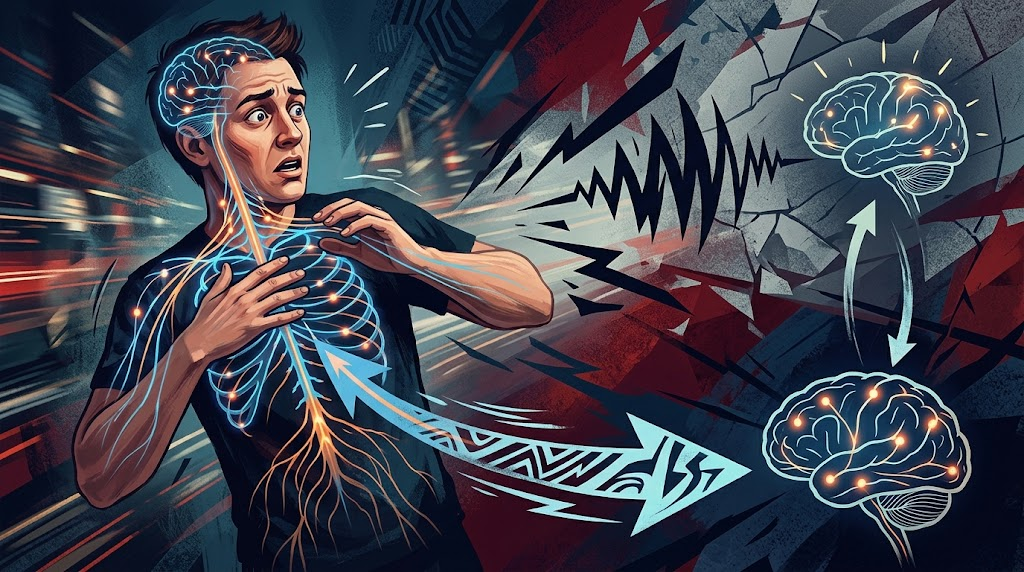
Have you ever walked into a room and felt your stomach tighten for no obvious reason? Or met someone new and instantly felt uneasy, even though nothing was actually wrong? That instant, unfiltered response is a visceral reaction — and it’s one of the most misunderstood forms of communication your body uses.
Visceral reactions aren’t random noise. They’re signals, generated deep inside your nervous system, that arrive before your conscious mind has time to reason things out. Learning to recognize, interpret, and work with these signals is at the heart of trauma-informed approaches like Somatic Experiencing® (SE™), and it’s also simply useful for anyone who wants a better relationship with their own body.
This guide breaks down what visceral reactions actually are, why they happen, how they show up, and what you can do to work with them rather than be ruled by them.
What Exactly Is a Visceral Reaction?
The word “visceral” comes from the Latin viscera, meaning internal organs. A visceral reaction, then, is a physical response that originates from those internal organs — most often the gut, but also the heart, lungs, and the broader autonomic nervous system.
Unlike a decision you consciously reason through, a visceral reaction happens automatically. It’s your body’s fast-response system kicking in before your thinking brain has finished processing what’s going on. A knot in your stomach, a sudden urge to leave a room, a racing pulse when you see a certain email land in your inbox — these are all visceral.
Importantly, visceral reactions aren’t inherently negative. They can just as easily show up as a warm, expansive feeling in your chest when you’re reunited with someone you love, or a settled calm that washes over you the moment you step into a familiar, safe space. The nervous system uses the same channels to broadcast both comfort and threat.
The Gut-Brain Connection: Why Your Stomach “Knows” Things First
One reason visceral reactions so often center on the gut is that the digestive tract has its own extensive nervous system — sometimes called the “second brain,” or more formally, the enteric nervous system. It contains hundreds of millions of neurons and communicates constantly with the brain through the vagus nerve, a major highway running between your gut and your central nervous system.
This gut-brain axis works in both directions. Emotional states can alter digestion, motility, and gut sensitivity. At the same time, signals originating in the gut — including those shaped by the trillions of microbes living there — can influence mood, stress reactivity, and even how quickly you notice danger or discomfort. That’s part of why chronic stress so often shows up as digestive trouble, and why gut health is increasingly discussed alongside emotional regulation.
The autonomic nervous system sits underneath all of this. Its sympathetic branch drives the fight-or-flight response, while the parasympathetic branch supports rest, digestion, and recovery. Visceral reactions are essentially the autonomic nervous system announcing which of these modes it has just shifted into.
Common Signs of a Visceral Reaction
Visceral reactions can show up differently from person to person, but the most common physical signals include:
- A tight or churning stomach, sometimes described as “butterflies”
- Sudden nausea or an urgent need to use the bathroom
- A racing or pounding heartbeat
- Shallow, rapid breathing or a lump in the throat
- Sweaty palms or a sudden change in body temperature
- Muscle tension, particularly in the jaw, neck, or shoulders
- Unexplained fatigue, lightheadedness, or a fast-onset headache
None of these are random. Each one reflects a specific shift in your autonomic nervous system, triggered by something your body has interpreted — correctly or not — as significant.
Why Do Certain People or Situations Trigger a Visceral Reaction?
It’s common to feel a strong, instinctive response to a particular person before you’ve consciously worked out why. This happens because the brain processes an enormous amount of nonverbal information — tone of voice, posture, micro-expressions, pacing of speech — far faster than it can put that information into words. Your body reacts to these cues before your conscious mind assembles a coherent explanation.
Past experience plays a major role here too. If a certain tone of voice, facial expression, or environment was present during a difficult or frightening experience in your history, your nervous system may flag similar cues in the present, even when the current situation is genuinely safe. This is why two people can walk into the same room and have completely different visceral experiences of it.
It’s worth remembering that a visceral reaction is information, not necessarily a verdict. It tells you something is worth paying attention to. It doesn’t automatically tell you what that something means.
Visceral Reaction vs. Visceral Pain vs. Gut Feeling
These three terms overlap but aren’t identical:
Visceral reaction is the broad category — any physical response, positive or negative, that originates in the internal organs and is linked to emotion or stress.
Visceral pain refers specifically to physical discomfort originating in internal organs, such as cramping, aching, or pressure in the abdomen, chest, or pelvis. It can be a sign of an underlying medical issue, such as irritable bowel syndrome, infection, or inflammation, and it’s usually harder to localize precisely than pain on the surface of the body.
Gut feeling describes the cognitive layer that often rides alongside a visceral reaction — the sense of “knowing” something, even without clear evidence. The physical sensation is the visceral reaction; the interpretation you attach to it is the gut feeling.
How Somatic Experiencing® Works With Visceral Reactions
Somatic Experiencing® (SE™), developed by Dr. Peter Levine, is a body-based therapeutic approach built around the idea that trauma isn’t only stored as memory — it’s stored physiologically, in patterns of nervous system activation that never fully resolved. Visceral reactions play a central role in this work.
Tracking and awareness. SE™ practitioners guide clients to notice bodily sensations as they arise — a tightening gut, shallow breath, tension in the shoulders — rather than jumping straight to analyzing the story behind them. This tracking helps surface a nonverbal narrative of past experience that talk alone often can’t reach.
Titration. Rather than diving fully into a distressing memory, SE™ uses small, manageable increments of activation. This keeps the nervous system from becoming overwhelmed and allows genuine processing to happen.
Pendulation. Clients are guided to move back and forth between states of activation and states of calm. This oscillation helps the nervous system relearn that it’s possible to return to safety after distress — one of the core mechanisms behind lasting change.
Discharge and regulation. Trauma can leave excess survival energy trapped in the body, often expressed through chronic tension, hypervigilance, or shutdown. SE™ supports the natural release of this energy — through trembling, deeper breathing, or spontaneous movement — so the nervous system can settle back into balance.
Integration. Over time, repeated, safe attention to visceral sensations helps the body and mind reconcile what happened. This reduces the grip old patterns have on present-day reactions, allowing a person to respond to current situations based on what’s actually happening now, rather than on old conditioning.
Can Visceral Reactions Be a Sign of Something Else Going On?
For most people, visceral reactions are a normal part of being human. But for some, the gut becomes persistently over-responsive to ordinary sensations like digestion, gas, or mild stretching — a state sometimes called visceral hypersensitivity. This heightened sensitivity is often associated with conditions such as irritable bowel syndrome and tends to be worsened by stress and anxiety.
If visceral reactions are frequent, intense, or paired with symptoms such as persistent abdominal pain, unexplained weight changes, blood in the stool, or ongoing digestive distress, it’s worth speaking with a healthcare provider. These could point to an underlying condition that benefits from medical evaluation, separate from the emotional and nervous-system components discussed here.
Practical Ways to Work With Visceral Reactions
You can’t switch off a visceral reaction the moment it starts, but you can build a healthier relationship with it over time.
Name it. Simply acknowledging, “this is a visceral reaction,” creates a small but meaningful gap between the sensation and your response to it.
Slow your breath. Long, slow exhales activate the parasympathetic nervous system, which helps counter the physiological arousal driving the reaction. A simple pattern — inhale for four counts, hold for four, exhale for six — is enough to begin shifting your state.
Ground yourself in the present. Notice physical details around you: your feet on the floor, the temperature of the air, five things you can see. This helps redirect attention away from the internal alarm and back toward your actual surroundings.
Track your patterns. Keeping a simple log of when visceral reactions occur, along with context like sleep, stress, and diet, often reveals patterns that aren’t obvious in the moment.
Practice self-compassion. Visceral reactions are not a character flaw or overreaction — they’re a normal nervous system function. Meeting them with curiosity rather than judgment tends to reduce their intensity over time.
Get support when needed. If visceral reactions are shaping your daily life, relationships, or wellbeing in ways that feel hard to manage alone, a therapist trained in body-based approaches — including Somatic Experiencing® — can help you work with these patterns directly rather than around them.
When to Seek Professional Support
Occasional visceral reactions are a normal part of being human. It’s worth reaching out for support when:
- Visceral reactions are frequent, intense, or disrupting your daily functioning
- You notice they’re tied to memories or relationships you haven’t been able to make sense of
- Physical symptoms (severe abdominal pain, unexplained weight loss, blood in stool, chest pain) are also present — these warrant a medical evaluation first
- You feel exhausted from constantly managing your body’s alarm system alone
A trauma-informed therapist trained in Somatic Experiencing, EMDR, or other body-based approaches can help you work with these reactions directly, rather than trying to think or push your way past them.
Frequently Asked Questions
What causes a visceral reaction?
Visceral reactions are triggered by your autonomic nervous system in response to perceived emotional or physical threat. Common causes include acute stress, unresolved trauma, strong emotions, and learned associations from past experiences.
Is a visceral reaction the same as anxiety?
They overlap but aren’t identical. Anxiety is a broader emotional and cognitive state; a visceral reaction is the physical sensation component, which can occur with anxiety, fear, excitement, or even positive emotions like love and anticipation.
Can visceral reactions be positive?
Yes. The warmth of a hug, the flutter before good news, or the calm that settles in a peaceful space are all visceral reactions too — your body’s way of signaling safety, connection, and reward.
How is Somatic Experiencing different from talk therapy?
Talk therapy primarily works with narrative and cognition. Somatic Experiencing works directly with bodily sensation and nervous system state, which can be especially helpful when trauma is stored below the level of conscious memory.
Can gut health affect visceral reactions?
Yes. The gut-brain axis means that your gut microbiome and digestive health can influence how sensitive your body is to stress and emotional triggers, and vice versa. Persistent digestive symptoms are worth discussing with a physician alongside any emotional work.
You Don’t Have to Interpret These Signals Alone
If your body has been sending you visceral signals for years and you’re ready to understand what they mean, Safe Space Psychotherapy offers trauma-informed, body-based therapy — including Somatic Experiencing and EMDR — for high-achievers, perfectionists, and anyone whose nervous system is ready for a different kind of safety.
Book an Appointment or explore our Trauma Therapy services to learn more.